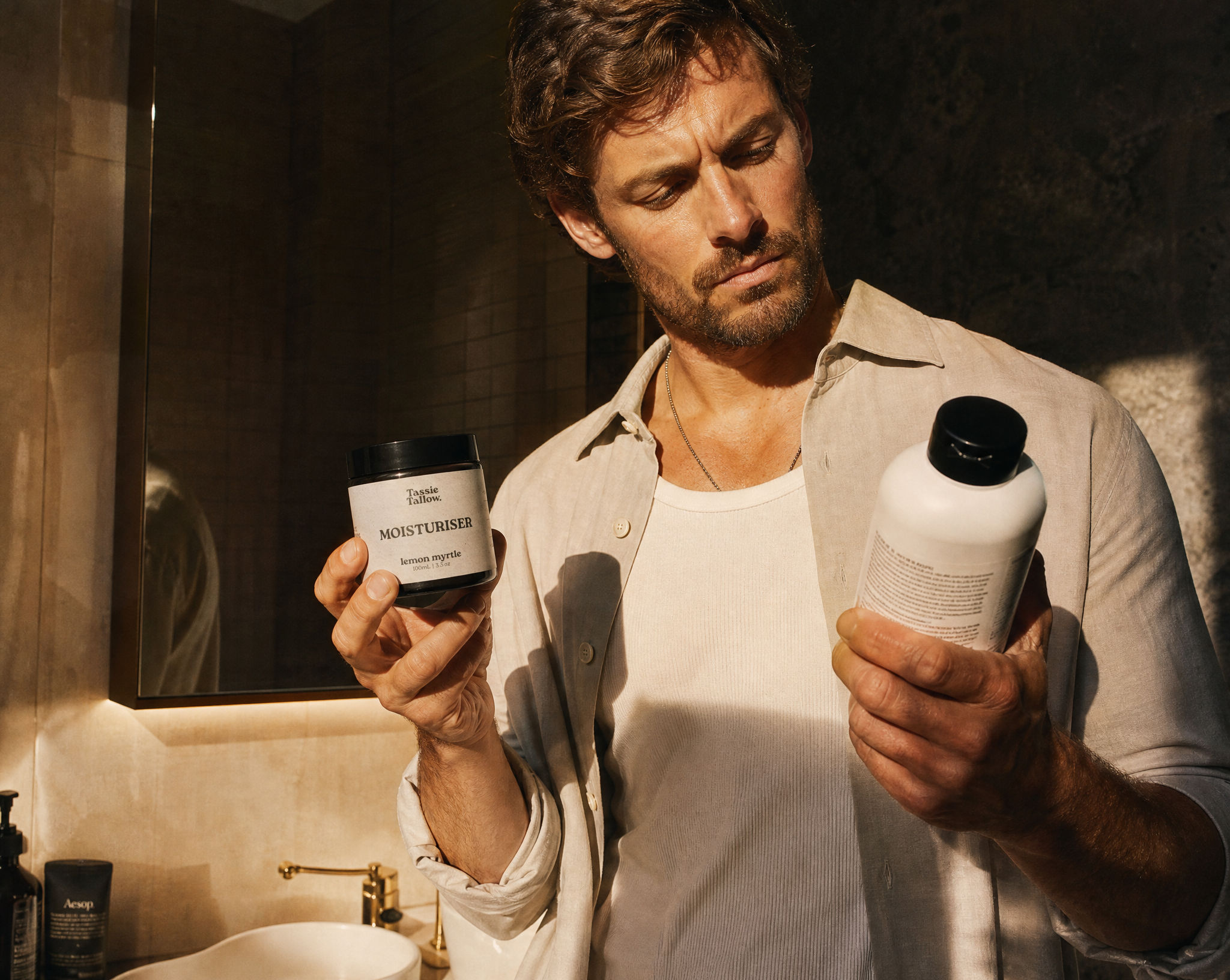
Pick up almost any moisturiser from a pharmacy or department store and read the ingredient list. Chances are you will find emulsifiers, preservatives, synthetic fragrances, silicones, alcohol derivatives, and a handful of ingredients with names that require a chemistry reference to interpret.
Now consider what is in a jar of Tassie Tallow: rendered grass-fed beef fat. That is the entire list.
The contrast is worth understanding - not as a condemnation of the conventional skincare industry, but as a genuinely useful framework for deciding what you put on your skin.
Why Conventional Moisturisers Have So Many Ingredients
The core formulation challenge for any water-based moisturiser is that oil and water do not mix. To create a stable emulsion - the creamy texture that most moisturisers have - manufacturers need emulsifiers. To keep that emulsion from growing bacteria, yeast, and mould over a twelve to twenty-four month shelf life, they need preservatives. To improve the skin feel, they add silicones, film-forming polymers, and smoothing agents. To make the product smell appealing, they add fragrance.
Most of these ingredients are serving the product rather than your skin. They are there to create a stable, aesthetically appealing formulation that will survive the shelf life required for retail distribution. The active ingredients that actually provide skin benefit - retinol, hyaluronic acid, niacinamide - are present in specific concentrations within this framework, often at relatively low percentages of the overall formula.
The Problem with Preservatives
Preservatives are necessary in water-based products because water creates the conditions for microbial growth. Parabens, phenoxyethanol, sodium benzoate, and their equivalents are effective at their job. However, for a significant proportion of people - particularly those with sensitive, compromised, or reactive skin - preservatives are a source of contact dermatitis and allergic sensitisation.
Tallow contains no water, which means no preservatives are needed. Its high saturated fat content makes it naturally resistant to rancidity. A well-made, properly stored tallow product is shelf-stable for twelve months or more without any preservative system. The shelf stability is inherent to the ingredient.
What Fragrance Is Doing
Fragrance is one of the most common causes of contact allergy and skin sensitisation in conventional skincare. The term 'fragrance' or 'parfum' on an ingredient list can represent a blend of dozens or hundreds of individual chemical compounds, many of which are known sensitisers at sufficient concentrations. This applies to 'natural' fragrance as much as synthetic - essential oils are biologically active compounds that can and do cause reactions in sensitive skin.
Unscented tallow carries a mild, clean fat scent that most people find entirely neutral. For those who want a pleasant fragrance, a small addition of a carefully chosen essential oil is optional - but the base product is complete without it, and for anyone with fragrance sensitivity, that is a significant advantage.
With tallow, you are not paying for water, emulsifiers, and preservatives to deliver a small fraction of active ingredient. The whole product is the active ingredient - and your skin recognises it.
Nutrient Density: A Direct Comparison
A standard moisturiser might contain two to five per cent of a key active ingredient - niacinamide, retinol, or hyaluronic acid - in a base that is predominantly water, emollients, and stabilising agents. Those active ingredients can be genuinely effective at the right concentrations, but they are working in isolation within a largely inert carrier.
Tallow is entirely nutrient-dense. Every component of it - the fatty acids, the fat-soluble vitamins A, D, E, and K2, the CLA, the squalene - is functional. There is no inert base diluting the active components because there is no inert base. The entire jar is the active ingredient, which means you are using less product to achieve more effect.
Cost Per Use
Quality tallow costs more per jar than a basic pharmacy moisturiser. The comparison changes when you account for how little product you need per application. Tallow is highly concentrated - a small amount goes significantly further than a water-based cream of the same nominal size. A 100g jar of Tassie Tallow, used correctly, will typically outlast two or three standard moisturisers. The cost-per-use comparison is considerably more favourable than the shelf price alone suggests.
Who Should Consider Making the Switch
Tallow is not a universal solution - no skincare ingredient is. But it is worth serious consideration if you have:
Sensitive or reactive skin that does not tolerate conventional moisturisers well
Eczema, psoriasis, or a compromised skin barrier that has not responded fully to pharmaceutical treatments
A preference for knowing exactly what you are applying to your skin
Dry skin that conventional moisturisers hydrate only temporarily before the dryness returns
A desire to simplify your skincare routine to fewer, higher-quality products
For many people who have spent years cycling through moisturisers without finding something that consistently works, tallow is the thing that finally does. The reason is usually the same: the skin recognises it as compatible, and responds accordingly.