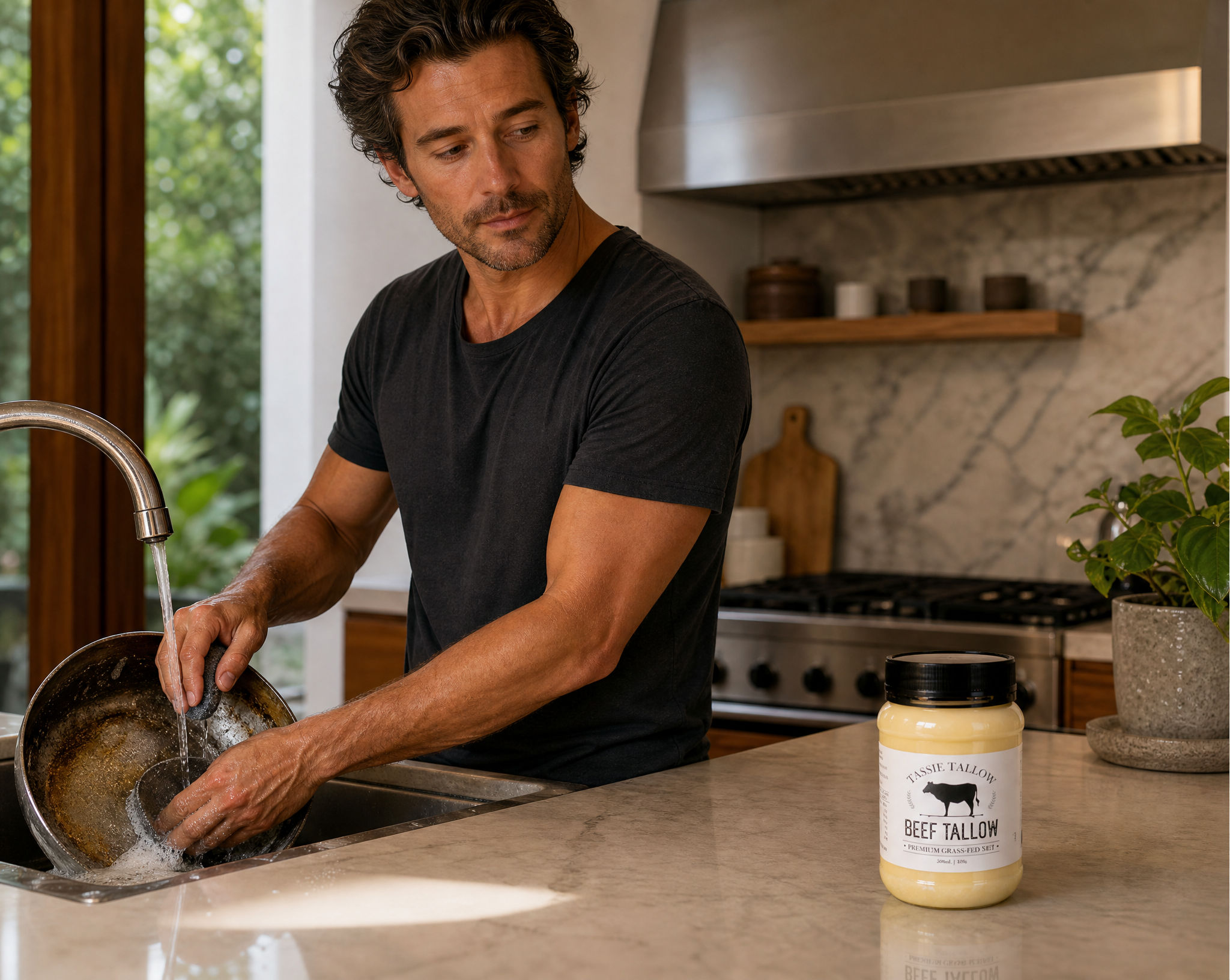
Most Australians cook with seed oils without giving it much thought. Canola, sunflower, vegetable blend - they are cheap, widely available, and have been marketed as the healthy choice for fifty years. But the picture is considerably more complex than the label suggests, and it is worth understanding what you are actually working with before you heat it up.
Here is an honest comparison of tallow against the most common cooking oil alternatives.
How Seed Oils Are Made
The production of most commercial seed oils is a multi-step industrial process. It typically involves high-temperature mechanical pressing followed by chemical solvent extraction using hexane, then degumming to remove phospholipids, then refining with sodium hydroxide to remove free fatty acids, then bleaching with activated clays to remove colour and impurities, and finally deodorising - heating the oil to temperatures that can exceed 250°C to remove flavour compounds produced during earlier processing steps.
By the time a bottle of canola or sunflower oil reaches your supermarket shelf, it has been significantly altered from its source material. The polyunsaturated fatty acids that make up a substantial proportion of seed oils are chemically unstable - prone to oxidation under heat, light, and air exposure. The industrial refining process subjects them to exactly the conditions most likely to cause that oxidation before they have even been cooked with.
Seed oils are often pre-damaged before they reach your kitchen. The refining process exposes unstable polyunsaturated fats to high heat and chemical treatment - producing oxidised compounds that are present in the oil before you have turned on your stove.
How Tallow Is Made
Tassie Tallow is made by slowly rendering grass-fed beef suet at low temperature. The fat melts, the impurities are strained out, and what remains is pure rendered tallow. No chemical solvents are used. No bleaching. No deodorising. The process is simple because the ingredient is good enough that nothing more is needed - and because every step of industrial refining that we avoid is a step that would compromise the nutritional integrity and flavour of the final product.
Stability Under Heat
Saturated fats - which make up the majority of tallow's composition - are chemically stable under heat because their fatty acid chains are fully saturated with hydrogen bonds, leaving no double bonds to react with oxygen. Polyunsaturated fats, which dominate in seed oils like canola, sunflower, and soybean, contain multiple double bonds that react readily with oxygen at cooking temperatures, producing aldehydes, ketones, and other oxidation products.
This is not theoretical. Studies examining the oils produced from deep-frying in seed oils have found elevated levels of toxic aldehyde compounds - compounds that are largely absent when stable fats like tallow are used at the same temperatures. The stability advantage of tallow is measurable and meaningful.
Nutrient Density
Grass-fed tallow contains fat-soluble vitamins A, D, E, and K2 in bioavailable forms - vitamins that are largely absent from refined seed oils, which have been processed to the point where most naturally occurring compounds have been removed or destroyed. Tallow also contains CLA (conjugated linoleic acid) and a beneficial omega-3 to omega-6 ratio that reflects the grass-based diet of the cattle it comes from.
Refined seed oils, by contrast, are essentially calorically dense but nutritionally empty - they provide fat energy without the accompanying micronutrients that whole-food fat sources carry. For anyone who cooks regularly and eats a lot of cooked food, the nutritional profile of their primary cooking fat has a cumulative effect on their diet over time.
Tallow vs. Butter
Butter is a closer comparison to tallow than seed oils - both are animal fats with genuine nutritional value and high saturated fat content. The key practical differences are smoke point and composition. Tallow's smoke point of approximately 250°C significantly exceeds butter's at around 150°C, making tallow the better choice for high-heat applications. Butter also contains milk solids - lactose and casein - which burn at low temperatures and can make high-heat butter cooking inconsistent. Tallow contains neither and behaves predictably at high heat. For finishing and lower-heat cooking, quality grass-fed butter is excellent. For searing, roasting, and frying, tallow is the more practical choice.
Tallow vs. Coconut Oil
Coconut oil is another popular alternative fat with genuine merit - it is stable, predominantly saturated, and has a pleasant flavour in the right context. Its smoke point of approximately 177°C is lower than tallow's, limiting its usefulness in high-heat applications. Its distinctive sweet, tropical flavour also limits its versatility in savoury cooking. Tallow's higher smoke point and more neutral flavour profile make it the more versatile option for everyday cooking across a wider range of dishes.
The Environmental Question
Tallow from pasture-raised cattle is a by-product of meat production - fat that would otherwise be discarded or rendered into non-food industrial uses. Using it as food is whole-animal utilisation that reduces waste. Canola and sunflower are annual monoculture crops requiring land clearance, irrigation, pesticide and herbicide application, and energy-intensive industrial refining. Neither picture is entirely simple, but the framing of plant-based equals sustainable does not survive close examination when the full production chain is considered.
The Bottom Line
On stability, nutrition, flavour, and production transparency, grass-fed tallow outperforms refined seed oils across the board. The choice is straightforward once you understand what is actually in your pan.