The sustainability of any food product comes down to a set of honest questions: where does it come from, what does it take to produce it, what gets wasted in the process, and what happens to the ecosystem it came from? These are not simple questions, and they rarely yield simple answers - but they are the right questions to ask, and tallow holds up well under them.
Here is a clear-eyed look at the sustainability case for grass-fed tallow, without the ideological framing that often surrounds discussions of animal-based foods.
What Nose-to-Tail Actually Means
Nose-to-tail eating is, at its core, a waste-reduction philosophy. If an animal is being raised and processed for food, using every edible part of it - not just the prime cuts that command the highest price - reduces the total resource cost per unit of nutrition produced. An animal that provides meat, organ meats, bone broth, and rendered fat represents a more complete and efficient use of the resources that went into raising it than an animal that provides only the loin and the rib.
Tallow is fat that would otherwise be largely wasted. In conventional meat processing, suet and other non-prime fats are either rendered into industrial non-food products - soap, cosmetics, biodiesel - or treated as a low-value by-product. Choosing to use it as food is not creating additional demand on the animal; it is finding the best possible use for something that was going to exist anyway. That is the nose-to-tail logic, and it is genuinely sound.
Tallow does not require an additional animal. It requires better, more complete use of the animal already being raised for meat. That distinction is the foundation of the sustainability argument, and it is a strong one.
The Seed Oil Comparison
The narrative that plant-based cooking oils are automatically the more sustainable choice does not survive close examination. Industrial seed oil production - canola, soybean, sunflower - requires substantial land clearance and monoculture agriculture, significant water use for irrigation in most growing regions, pesticide and herbicide application across large areas, and energy-intensive industrial refining that involves chemical solvents, high-temperature processing, and waste streams of its own.
The environmental footprint of a bottle of refined canola oil includes the footprint of the crop, the chemicals used to grow and protect it, the industrial extraction and refining process, and the transportation and packaging of a product with a global supply chain. None of this makes seed oils uniquely destructive - all food production has environmental costs. But the automatic assumption that plant-based equals sustainable is not supported when the production process is examined honestly.
Regenerative Agriculture and Pasture-Raised Systems
The environmental picture for grass-fed, pasture-raised tallow is meaningfully different from the picture for feedlot-derived animal fat - and the distinction matters for the sustainability argument. The critique of animal agriculture's environmental impact is largely a critique of intensive, grain-fed, high-density systems. Pasture-raised systems on well-managed land tell a different story.
Grass-fed cattle on properly managed pasture contribute to soil health through their grazing and movement patterns. Manure distributed across pasture functions as a natural fertiliser, supporting soil biology and reducing the need for synthetic fertiliser inputs. Well-managed grazing land can maintain or even increase soil carbon stocks over time. The biodiversity of managed pasture - the insects, birds, and soil organisms it supports - is considerably greater than that of intensively cultivated annual crop land.
This is not a universal claim about all cattle farming. It is a specific claim about well-managed pasture systems in appropriate landscapes - the kind that Tassie Tallow sources from in Tasmania - and the distinction between these systems and intensive feedlot or annual monoculture production is ecologically significant.
Tasmanian Land and Supply Chain
Tasmania's agricultural conditions - clean water, high annual rainfall, temperate climate, year-round pasture - mean that the land supporting Tassie Tallow's supply chain is genuinely suited to cattle grazing as a land use. The paddocks our supply chain draws from have been managed over generations. The relationship between the land, the animals, and the people farming it is not extractive in the way that intensive industrial systems are.
The supply chain is also geographically compact by the standards of most food products. Tasmanian-sourced fat rendered in Tasmania and distributed primarily to Australian customers involves considerably less freight, cold chain infrastructure, and logistical complexity than most imported food products or nationally distributed industrial foods.
Packaging and Waste
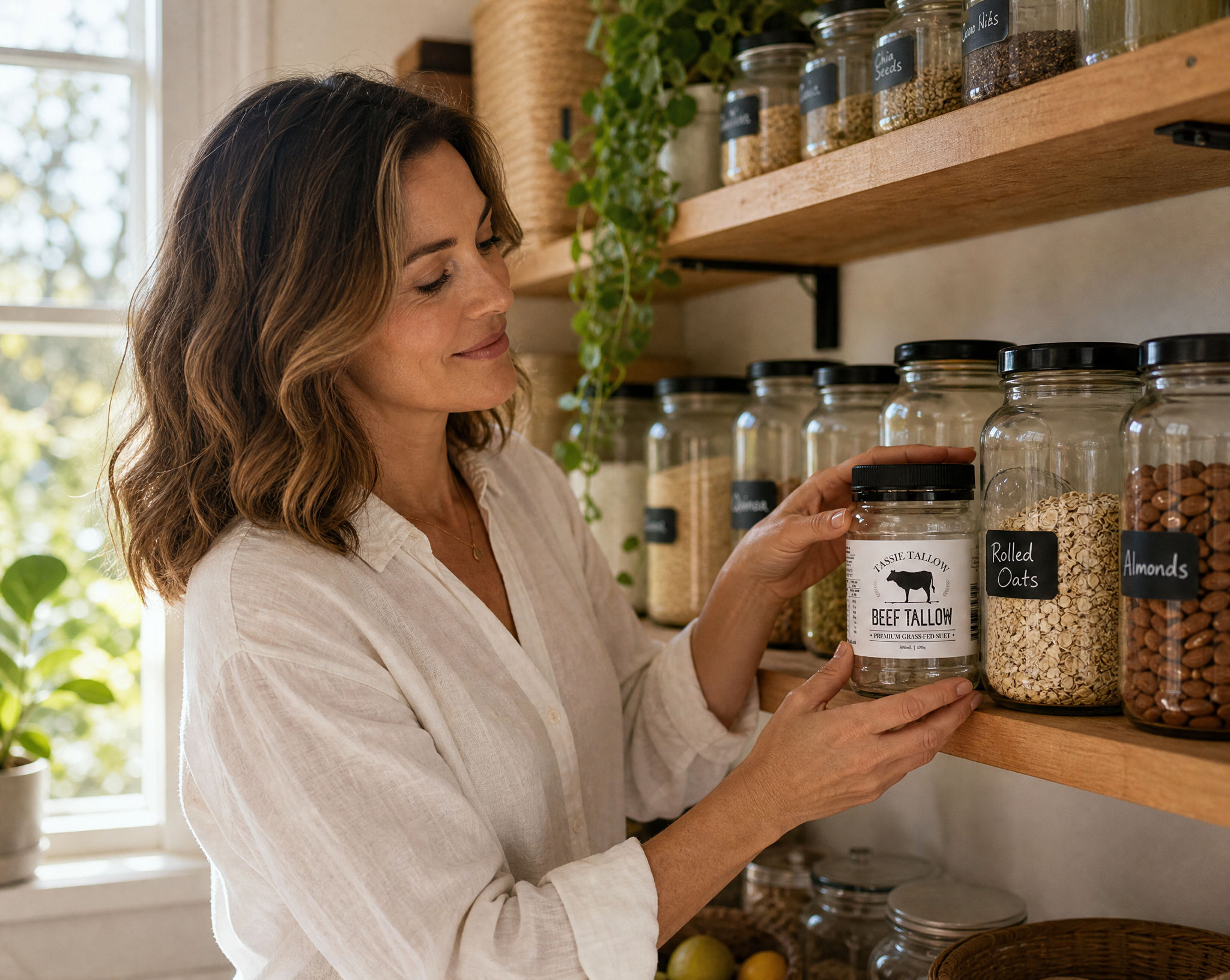
Tassie Tallow is packaged in glass jars - a material that is genuinely and repeatedly recyclable, with a significantly lower environmental footprint over its lifecycle than the multilayer plastic or composite packaging used by many food products. We keep our packaging functional and minimal: no outer carton, no excessive materials, no decorative elements that add cost and waste without adding value.
The product itself generates no food waste in normal use. Tallow can be completely used - scraped clean from the jar, used to the last gram - and the jar recycled or repurposed. There is no unusable residue, no packaging that cannot be processed, and no component of the product that ends up in landfill unnecessarily.
An Honest Position
We are not claiming that choosing tallow will resolve complex systemic food system problems, or that any single ingredient choice carries the weight of an environmental position. What we are saying is more modest and more grounded: when evaluated honestly against the realistic alternatives - industrially refined seed oils from opaque supply chains and resource-intensive monoculture agriculture - grass-fed tallow from a traceable Tasmanian pasture-raised source is a reasonable, defensible choice.
The nose-to-tail philosophy is not a brand story. It is a genuine attempt to use the whole animal, reduce waste, and support a food system that makes ecological and nutritional sense. In a market full of complicated supply chains and difficult trade-offs, that clarity is worth something.